
In honor of Black History Month, we’d like to introduce you to Dr. Whitfield Winsey (1842-1919)
In 1867, Dr. John Richard Woodcock Dunbar began tutoring Whitfield Winsey, who became the first African-American physician admitted to the Medical & Chirurgical Faculty.
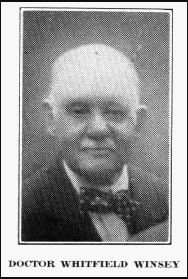
Dr. Dunbar probably had a great influence on Winsey’s acceptance into Harvard Medical School. As a graduate of the prestigious University of Pennsylvania Medical School and the founder of the Baltimore Medical Institute, Dr. Dunbar had important connections in the medical community which would prove to be an immense help to Winsey, an up-and-coming black physician.
In 1882, Winsey became the first black physician admitted to the Medical and Chirurgical Faculty of Maryland. His connections to Dunbar, even after Dunbar’s death, served him well.
An article on Dr. Dunbar’s death a week earlier in the Sun stated “He was preceptor [tutor] of a large number of the graduates of medicine in this city, having as high as twenty-five students at one time in his office during the sessions of the medical college here. Many of his students have risen to eminence in the profession.”
Winsey may be fairly counted among those eminent students, especially as his accomplishments were not only of importance to his profession. With the memory of Dr. Dunbar so fresh in their minds, his colleagues at the Faculty helped Winsey in his efforts to gain recognition of his talents in the larger medical community. Through this accomplishment, Winsey was able to break down the barriers of race.
Winsey set up his medical practice out of his home at 1220 E. Fayette St. in 1872. During the 1870s and ‘80s, Winsey’s name appeared in the pension files of several black Civil War veterans as their physician. This was the beginning of a prosperous career serving his fellow African Americans professionally, both as a business and a social service, as can be seen in his later medical associations.
In 1894, a group of prominent black physicians founded Provident Hospital on Orchard Street, which was the first private teaching hospital for blacks in Baltimore.
In 1902, the hospital moved into two remodeled residences on Biddle Street. Winsey was an instructor at Provident, which provided teaching for colored internists.
In 1901, Winsey became the treasurer and physician for the Industrial Home for Colored Girls at Melvale, a post which he held for eighteen years until his death.
According to his biography in the Medical Annals of Maryland, Winsey was also a Delegate to the International Medical Congress at Washington. In addition, Winsey was the author of several papers before the Faculty, the Clinical Society of Maryland, and the Medical Congress. Sometime before his death in 1919, Winsey also became a member of the American Medical Association.
Although Winsey was employed as a physician at black institutions such as the Melvale Home and Provident Hospital, he belonged to white fraternal and professional organizations. Perhaps Winsey saw entry into traditionally white organizations as a way to further break down racial barriers, or to further his career. Perhaps his sponsors saw helping Winsey as a contribution to the advancement of his race, and perhaps his light skin color made that process easier. Membership in such societies indeed had a positive influence upon his career, although Winsey was unable to cross the color bar and work in white institutions.
Dr. Whitfield Winsey provided leadership for many aspects of nineteenth century African American society in Baltimore. As a member of the small but growing cadre of black physicians in the city, the Harvard-trained Winsey served as the black voice on the Medical and Chirurgical Faculty of Maryland, a prestigious medical society that he joined in 1882.
Like most other black professionals of nineteenth century Baltimore, Winsey’s professional stature brought the burden of responsibility to his race, which he bore well. And, as the Baltimore Sun reported, Winsey’s rise was indicative of “the advances made by blacks during the late-nineteenth century.”